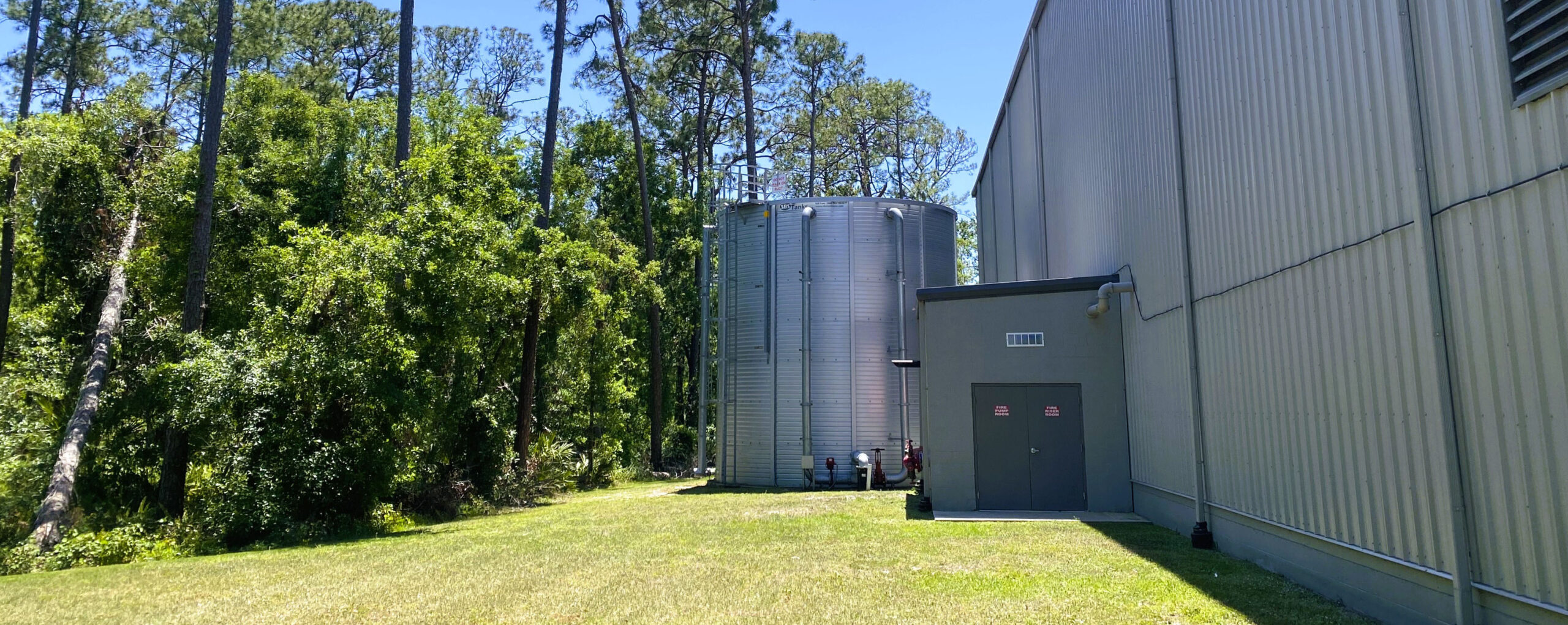

The rapid rise of artificial intelligence is reshaping the American economy. Across the country, technology companies are investing billions of dollars in new data centers to support cloud computing, machine learning and AI-driven applications. States such as Texas, Georgia, Arizona, North Carolina, South Carolina and Tennessee have become hotspots for data center development with new facilities being planned and constructed at an unprecedented pace.
Much of the conversation surrounding data centers focuses on electricity. Power availability, grid capacity and renewable energy commitments dominate headlines and planning discussions. However, another critical resource is becoming increasingly important in the design and operation of these facilities: water.
As data center campuses continue to grow in size and complexity, developers, engineers, utilities and operators are beginning to recognize that water resilience may be just as important as energy resilience. From cooling systems and fire protection infrastructure to rainwater harvesting and alternative water sources, water storage is emerging as a critical component of long-term operational reliability.
 For companies like SBS Tanks (www.sbstanksusa.com), which designs and manufactures modular steel water storage solutions for commercial, industrial, utility, fire protection, and rainwater harvesting applications, this shift represents a growing opportunity to help data center operators build more resilient infrastructure capable of supporting future growth.
Data Centers Have Become Critical Infrastructure
Modern data centers are no longer simply warehouses filled with servers. They have evolved into mission-critical infrastructure supporting everything from financial transactions and healthcare systems to cloud computing platforms and artificial intelligence applications.
Downtime is not merely inconvenient – it can be extraordinarily costly. As a result, data center developers routinely invest in redundant power systems, backup generators, battery storage and multiple network connections to ensure uninterrupted operation.
Water resilience deserves similar consideration.
While cooling technologies vary between facilities, many data centers require substantial volumes of water to support cooling operations. In regions experiencing population growth, drought conditions or increasing pressure on existing infrastructure, securing a reliable water supply is becoming an important planning consideration.
This challenge is particularly evident in fast-growing markets such as Texas, Arizona, Georgia, and the Carolinas where water resources are increasingly under scrutiny and utilities are evaluating the long-term impact of large-scale developments on existing water infrastructure.
Water Storage Is Becoming a Strategic Asset
Historically, water storage at data centers was often viewed as a supporting utility. Today, it is increasingly being recognized as a strategic asset.
Operators are looking beyond simple supply connections and considering how on-site water storage can improve operational resilience. Large-capacity storage tanks can provide backup water reserves, support cooling systems during supply interruptions, assist with maintenance activities and contribute to broader sustainability objectives.
The ability to store significant volumes of water on-site can also reduce dependence on utility systems during periods of peak demand or infrastructure disruptions.
As communities become more focused on water conservation and resource management, facilities that can supplement utility supplies through stored water, reclaimed water, or rainwater harvesting may be better positioned to support long-term growth while minimizing strain on local infrastructure.
Cooling Systems Are Driving New Water Strategies
The continued growth of artificial intelligence workloads is increasing computing density within data centers. Higher computing density generates more heat, requiring increasingly sophisticated cooling solutions.
While air-cooled systems remain common, many operators are evaluating liquid cooling technologies and hybrid cooling systems to improve efficiency and support next-generation computing equipment.
These evolving cooling requirements are encouraging operators to adopt more comprehensive water management strategies. Rather than relying solely on utility water supplies, many organizations are exploring diversified approaches that include reclaimed water, rainwater harvesting systems, and dedicated water storage infrastructure.
Stored water can provide additional flexibility, helping operators manage fluctuations in demand while creating opportunities to integrate sustainable water practices into facility operations.
Rainwater Harvesting Moves Beyond Sustainability
Rainwater harvesting has traditionally been associated with green building initiatives and environmental stewardship programs. However, its role is evolving.
For many commercial and industrial facilities, rainwater harvesting is increasingly viewed as a practical component of water resilience planning.
Large roof areas commonly found on data centers create significant opportunities for rainwater collection. Captured rainwater can be stored and utilized for various non-potable applications, reducing dependence on utility water supplies while supporting broader sustainability objectives.
When combined with appropriately sized storage infrastructure, rainwater harvesting can become an important component of a comprehensive water management strategy.
This shift reflects a broader trend occurring across multiple industries: water is no longer viewed solely as a utility expense. It is increasingly being treated as a strategic resource that must be managed carefully to support operational continuity and future growth.
 Fire Protection Cannot Be Overlooked
While cooling systems often dominate discussions about water use in data centers, fire protection remains equally important.
Data centers contain high-value equipment and support mission-critical operations. Consequently, fire protection infrastructure must be designed to meet stringent requirements while ensuring dependable water availability during emergency situations.
Dedicated fire water storage tanks provide an important layer of protection, particularly for facilities located in areas where utility infrastructure may not be capable of delivering required fire flows or where redundancy is a key operational objective.
Many data center developments incorporate dedicated fire protection water storage systems designed in accordance with NFPA 22, the Standard for Water Tanks for Private Fire Protection. NFPA 22 establishes requirements for the design, construction, installation, and maintenance of fire protection water tanks, helping ensure a reliable and compliant water supply is available when needed most. Automatic sprinkler and draft-type fire suppression systems rely on professionally engineered storage tanks that can consistently deliver the required water volume and flow rates during an emergency.
To support these requirements, SBS Tanks offers a dedicated range of NFPA 22 Fire Protection Water Tanks (https://sbstanksusa.com/our-solutions/water-tanks/applications/fixed-fire-protection-water-tanks/). Available in both the Standard (ST) and Cyclonic (CY) ranges, these modular steel tanks are engineered to provide reliable fire water storage capacities ranging from approximately 3,170 gallons to more than 1.1 million gallons. The tanks are designed to meet NFPA 22 compliance requirements while offering rapid installation, long service life, and minimal maintenance requirements. Fire Protection Engineers (FPEs) and Authorities Having Jurisdiction (AHJs) across the United States have approved SBS Tanks for numerous fire water storage applications.
As operators seek greater resilience and risk mitigation, dedicated fire water storage designed to meet applicable NFPA requirements is becoming an increasingly important component of overall facility planning.
As data center campuses continue to expand, the need for reliable, large-capacity fire water storage solutions is expected to grow alongside cooling-related water requirements.
Selecting the Right Water Storage Solution
Not all water storage systems are equally suited to the demands of modern data center projects.
Developers increasingly seek solutions that combine durability, rapid installation, low maintenance requirements, and long service life. Modular tank systems are particularly attractive because they can be installed efficiently while accommodating future expansion plans.
SBS Tanks offers two product ranges that are particularly well suited for data center applications.
The company’s Standard (ST) Standard Water Tank Range – SBS USA range provides a versatile water storage solution suitable for fire protection water storage, cooling water reserves, rainwater harvesting systems, process water storage and general site water management requirements. Designed using high-tensile steel and SBS Tanks’ proven liner technology, the ST range delivers reliable long-term performance while minimizing maintenance requirements. The range is widely suited to data center applications where operators require dependable water storage for both operational and emergency response needs, including NFPA 22-compliant fire protection systems.
For locations exposed to extreme environmental conditions, the company’s Cyclonic (CY) Cyclonic Water Tank Range – SBS USA range offers enhanced structural capabilities engineered to withstand higher wind loading requirements. This makes the CY range particularly attractive for data center developments located in hurricane-prone regions of the United States, including Texas, Florida, the Gulf Coast, and the Southeastern seaboard.
Both tank ranges can be configured to support a wide range of storage capacities, allowing developers to scale water storage infrastructure alongside facility growth. With storage capacities ranging from approximately 3,170 gallons to more than 1.1 million gallons, SBS Tanks can support everything from smaller edge computing facilities to large hyperscale data center campuses.
Planning for the Future
As artificial intelligence continues to drive unprecedented investment in digital infrastructure, water will play an increasingly important role in data center planning and operations.
The industry’s future success will depend not only on access to power but also on the ability to secure, store and manage water resources effectively. Facilities that incorporate resilient water storage strategies, dedicated fire protection reserves and sustainable water management practices will be better positioned to support long-term operational reliability.
The data center boom may be powered by electricity, but its future resilience will depend on much more than power alone. Increasingly, water storage is becoming a critical part of the infrastructure equation – and one that developers can no longer afford to overlook.
About SBS Tanks
SBS Tanks designs and manufactures modular steel water storage tanks for commercial, industrial, utility, fire protection, rainwater harvesting, agricultural, and municipal applications. With storage capacities ranging from approximately 3,170 gallons to more than 1.1 million gallons, SBS Tanks provides scalable water storage solutions designed to meet diverse project requirements and site conditions.
The company’s Standard (ST) and Cyclonic (CY) tank ranges are engineered for long-term durability, reliable performance, and efficient installation. SBS Tanks’ solutions are used across the United States and internationally in applications where dependable water storage is critical to operational resilience, fire protection, and sustainable water management.
Contact
Allan Prinsloo
Business Development – SBS Tanks USA
Email: allan.p@sbstanksusa.com
Website: www.sbstanksusa.com
© SBS Holdings 2026
