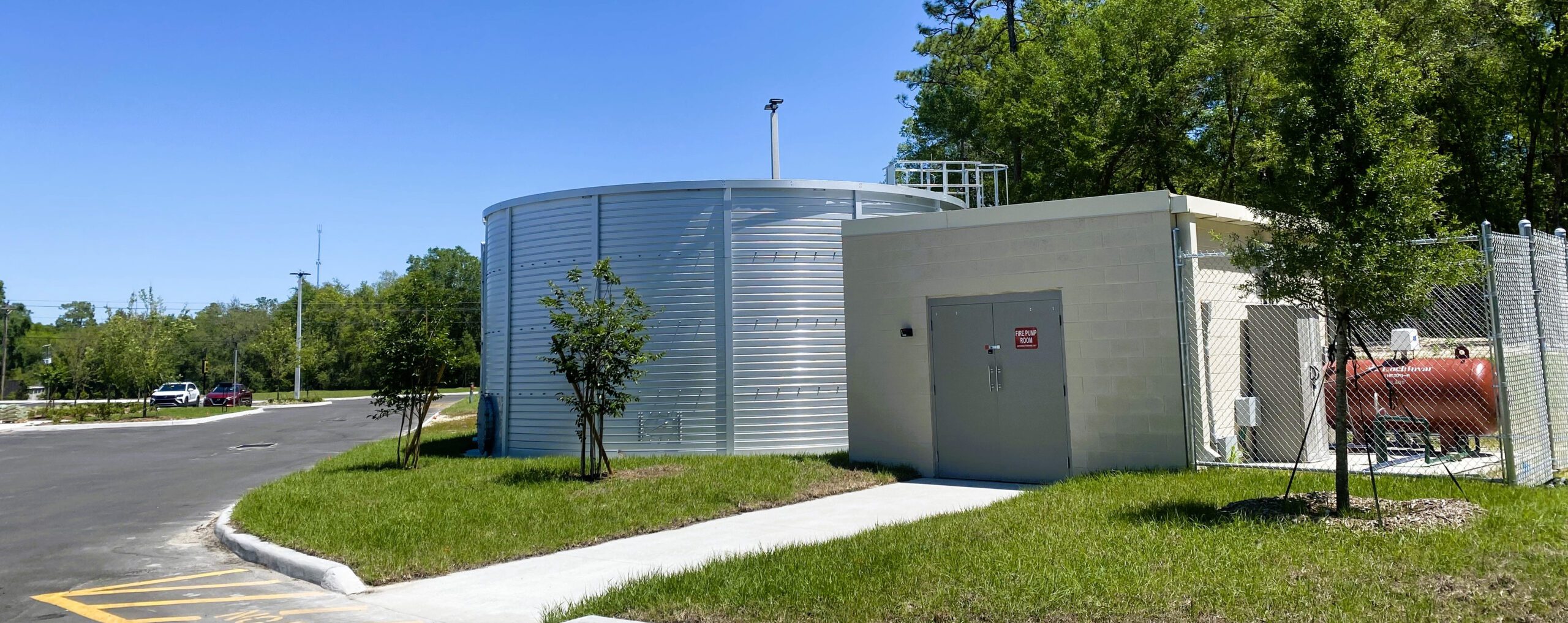

With the 2026 Atlantic hurricane season approaching, resilience planning is again moving to the front of infrastructure conversations across Florida, the Gulf Coast and the southeastern United States. The official Atlantic storm-name list for 2026 begins with Arthur, Bertha, Cristobal, Dolly, Edouard and Fay nhc.noaa.gov/aboutnames.shtml – a timely reminder that preparation starts before the first named system enters the forecast cone. For facilities relying on fire protection water storage, the question is not only whether a tank can store the required volume, but whether it can remain structurally secure when hurricane-force winds arrive.
For fire protection engineers, fire sprinkler contractors and owners, wind-load terminology can create confusion. A tank may be described by a nominal wind rating, while the actual structural design is checked using ultimate wind load conditions. Understanding the difference is essential when specifying tanks in high-wind regions such as South Florida, where water storage forms part of a life-safety system.
Bolted steel water tanks present a unique wind-design challenge. Their cylindrical shape creates a large exposed surface area, and when the tank is empty there is no stored water mass to help resist uplift or overturning. For this reason, SBS Tanks Cyclonic Water Tank Range – SBS USA designs wind loading around the empty tank condition – the most critical and conservative scenario.
This matters in real projects. A tank may be empty during commissioning, inspection, maintenance, or after a system drawdown. If a hurricane occurs during one of these conditions, the tank must rely on its engineered shell, anchoring system and foundation to remain stable. Designing for a partially filled tank may reduce calculated demand on paper, but it does not represent the true worst-case condition.
SBS Tanks provides wind-rated solutions through its Standard water tank range and Cyclonic water tank range. These ranges are often discussed in terms of nominal wind load ratings:
The nominal value is a useful classification tool. The ultimate value is what matters when evaluating extreme-event performance. Ultimate wind conditions include safety factors that reflect peak storm demands and structural uncertainty, meaning the tank is engineered for forces higher than the nominal rating alone suggests.
This distinction is especially important in hurricane-prone regions. Moving from a standard wind-rated tank to a cyclonic-rated tank is not a small step. Wind pressure increases rapidly as wind speed rises, so uplift, overturning and anchoring forces increase significantly.
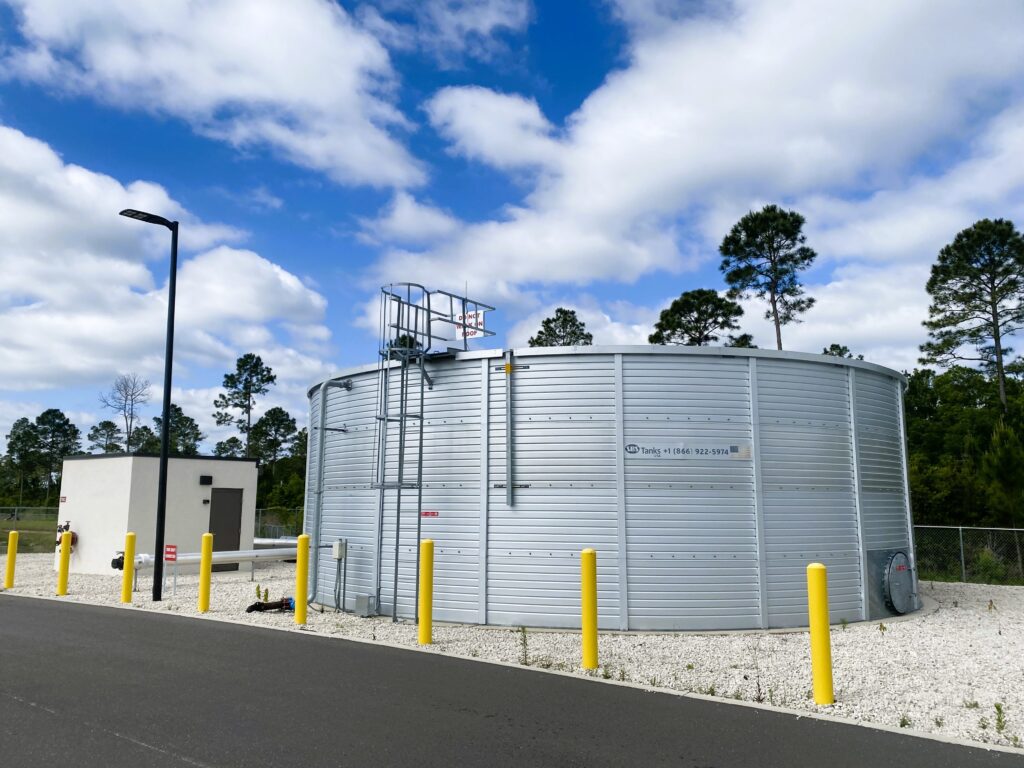
One of the most important specification questions is the assumed tank condition used for wind design. SBS Tanks designs for the empty tank condition because that is the most vulnerable state. In contrast, some designs in the market reference wind loading based on a partially filled tank, such as one-third full. While added water weight helps resist uplift and overturning, it also lowers the apparent design demand and may not reflect real-world conditions.
For fire protection applications, this distinction should be discussed clearly during specification review. A tank intended to protect people, property and business continuity should be assessed under the condition where it is most at risk.
The Dania Beach distribution center project in South Florida provides a practical example of cyclonic tank design in action. SBS Tanks supplied a 60,600-gallon NFPA 22-compliant fire protection water tank for a new logistics facility, supporting the site’s sprinkler system and helping the development meet its fire protection requirements. The project brief identifies the tank as a CY13R04 model installed for a warehousing and distribution application in Dania Beach, where hurricane exposure is a central design consideration.
Dania Beach is located in Broward County, within South Florida’s high-wind environment. Public Florida wind-load guidance commonly identifies Broward County Risk Category II wind speeds at approximately 170 mph ultimate, with higher values for more critical categories depending on the project classification, exposure and engineer of record requirements. Against this backdrop, the SBS Tanks cyclonic solution – rated at 150 mph nominal, or approximately 171 mph ultimate – aligns directly with the high-wind demands typical of the area.
For this project, the practical message is clear: the nominal rating communicates the class of tank supplied, while the ultimate value communicates the level of storm-force performance the design is intended to resist.
Cyclonic performance depends on how the entire system works together. Tank panels, wind girts, roof components, anchoring systems, access openings and foundations all contribute to load transfer. Project drawings and calculations for cyclonic tank designs show the importance of wind girts, hold-down anchoring, reinforced concrete ring beams, roof uplift resistance and engineered appurtenance details.
In high-wind conditions, the tank shell must resist pressure acting across the exposed surface. Anchors must resist uplift and overturning where tank self-weight is insufficient. The foundation must distribute those loads into the ground, while site-specific soil conditions must be evaluated where bearing capacity or expansive soils may affect performance.
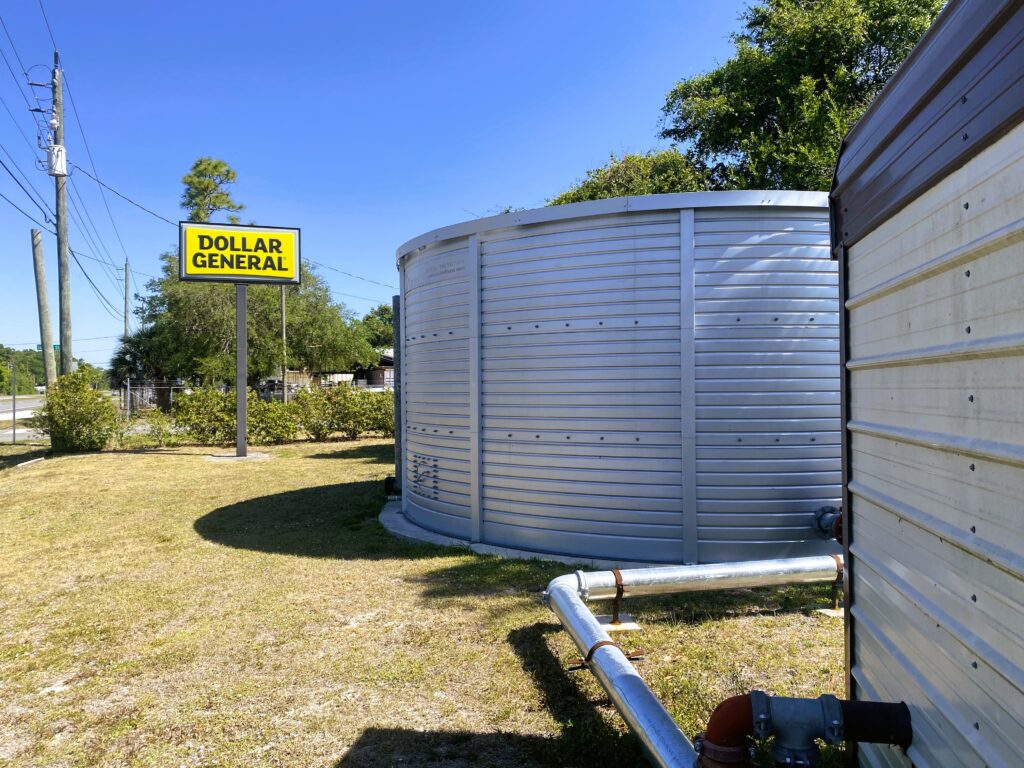
Building codes establish minimum requirements, but recent hurricane seasons have reinforced the value of resilient, risk-aware design. Storm behavior across the Gulf and Southeast has shown increasing variability and intensity, and critical infrastructure owners are increasingly focused on continuity after major events.
For fire protection water storage, a tank failure during or after a hurricane can compromise sprinkler readiness, delay occupancy, interrupt operations and expose facilities to avoidable risk. Specifying a cyclonic tank with a 150 mph nominal rating and approximately 171 mph ultimate wind condition provides added confidence in regions where high winds govern design.
SBS Tanks has developed its Cyclonic water tank range Cyclonic Water Tank Range – SBS USA for regions exposed to tropical storms, hurricanes and other high-velocity wind events. The range is engineered to provide resilience where structural performance is critical, including fire protection, municipal, commercial and industrial water storage applications.
Compared with the Standard range, the Cyclonic range offers a substantial increase in wind resistance. The Standard range serves general applications up to 100 mph nominal wind class, while the Cyclonic range provides the 150 mph nominal class required for many hurricane-prone sites. Under ultimate conditions, these correspond to approximately 114 mph and 171 mph respectively.
By focusing on ultimate performance, empty-tank wind loading, high-capacity anchoring and site-specific foundation requirements, SBS Tanks supports project teams with systems designed for the conditions they are likely to face – not only the conditions they hope to avoid.
SBS Tanks specializes in engineered modular bolted steel water storage solutions for fire protection, municipal, commercial, industrial, agricultural and rainwater harvesting applications. Its tank systems are designed for durability, rapid installation and long-term performance across a wide range of environmental conditions, including high-wind and cyclonic regions.
More information can be found at www.sbstanksusa.com.
© SBS Holdings 2026
