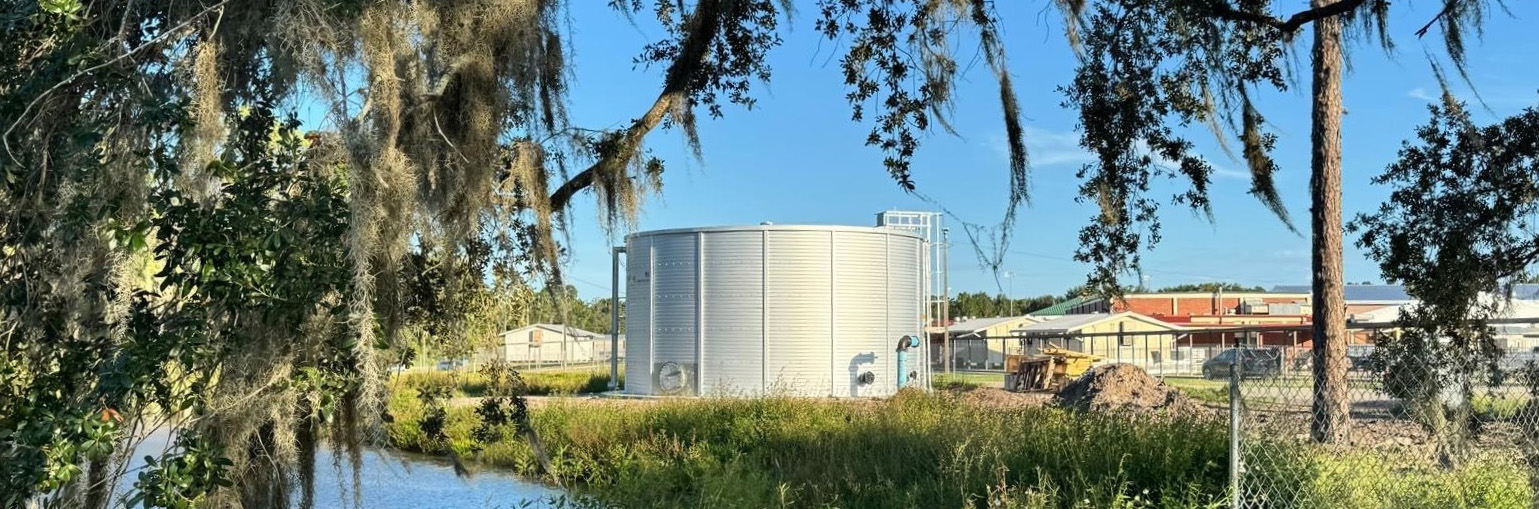

For decades, fire protection water storage has been viewed primarily through the lens of code compliance. If a project met the applicable fire codes, satisfied the Authority Having Jurisdiction (AHJ) and provided the required fire flow, the objective had been achieved.
Today, that mindset is changing. Across the United States, manufacturing plants, distribution centers, data centers, food processing facilities, logistics hubs and commercial developments are becoming larger, more automated and increasingly critical to the nation’s economy. At the same time, rising insurance costs, aging utility infrastructure, rapid industrial growth and more frequent extreme weather events are forcing owners, developers, and engineers to think differently about risk.
The question is no longer simply, “Does this project comply?” Increasingly, owners are asking a more strategic question: “Will this facility continue operating if something goes wrong?” That shift is transforming fire water storage from a regulatory requirement into a critical infrastructure investment that supports business continuity, operational resilience, and long-term asset protection.
For companies such as SBS Tanks who design and manufacture modular steel water storage solutions for fire protection, industrial, commercial, utility and rainwater harvesting applications, this evolution reflects a broader change in how organizations evaluate water storage. Rather than viewing a fire water tank as simply another line item on a construction budget, many owners now recognize it as an investment in protecting people, property, and business operations.
Fire protection standards remain the foundation of every successful fire protection system.
For private fire protection water storage, NFPA 22 – Standard for Water Tanks for Private Fire Protection establishes the requirements for the design, construction, installation, and maintenance of fire protection water tanks. Working alongside standards such as NFPA 13 and NFPA 20, NFPA 22 helps ensure that sprinkler systems and fire pumps have access to a dependable water supply capable of delivering the required flow and duration during an emergency.
Compliance with these standards is essential. However, standards establish the minimum acceptable level of protection. Today’s industrial facility owners increasingly recognize that minimum compliance does not necessarily equate to maximum resilience.
As facilities become more technologically advanced and operationally critical, fire protection infrastructure is being evaluated not only for its ability to satisfy code, but also for its contribution to long-term business continuity.
Modern industrial facilities represent significant capital investment. Distribution centers support national supply chains. Manufacturing plants operate around the clock. Food processing facilities maintain continuous production schedules. Data centers host the digital infrastructure that powers businesses, financial institutions, healthcare providers, and government agencies.
When fire interrupts these operations, the financial impact extends well beyond repairing damaged buildings. Production stops. Customer deliveries are delayed. Supply chains are disrupted. Employees may be unable to work. Contractual obligations may be missed. Customer confidence can be affected.
For many organizations, the cost of operational downtime can far exceed the direct cost of the fire itself. This reality is changing the way owners evaluate fire protection investments. Rather than asking, “What is the minimum water storage required?”, many are asking “What level of resilience does our business require?” Reliable fire water storage is becoming part of a broader business continuity strategy designed to reduce operational risk before an emergency occurs.
Another factor driving this shift is the increasing pressure being placed on utility infrastructure throughout many parts of the United States. Population growth, industrial expansion and new commercial developments continue to increase demand on existing water systems. In rapidly developing regions, utilities are often challenged to provide sufficient fire flows for large industrial facilities without costly infrastructure upgrades.
Even where today’s capacity is adequate, future development can place additional demands on the same water network. For developers, relying solely on utility infrastructure introduces an element of uncertainty. Dedicated fire water storage removes much of that uncertainty. By maintaining a dedicated water reserve designed specifically for fire suppression, facility owners can provide a dependable water supply that remains available regardless of fluctuations within the surrounding utility network. This approach not only supports compliance with NFPA requirements but also provides greater confidence that fire protection systems will perform when needed most.
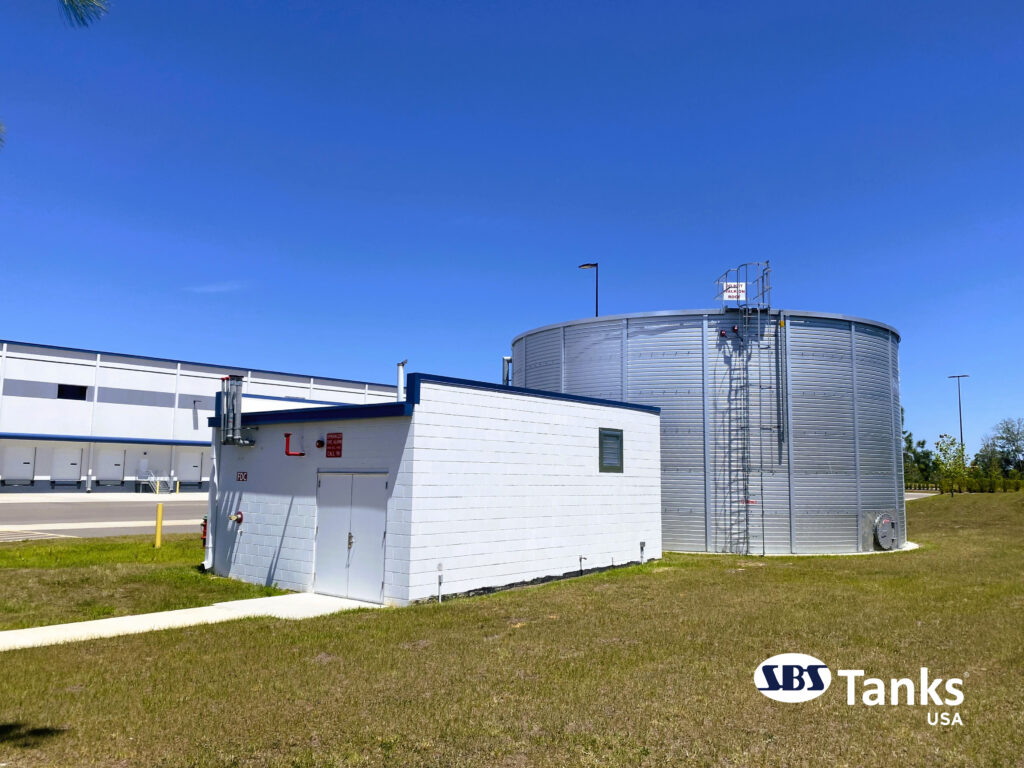
Industrial developments rarely remain static. Manufacturing plants expand production lines. Distribution centers increase warehouse capacity. Food processors install new production equipment. Data center campuses are commonly developed in multiple phases.
Planning fire protection water storage solely around today’s operational requirements can create expensive challenges tomorrow. Forward-thinking owners are increasingly considering future expansion during the initial design stage. Allowing for additional storage capacity or selecting modular systems that can accommodate future growth often proves far more economical than retrofitting infrastructure years later.
This long-term approach aligns with broader infrastructure planning principles, where resilience and scalability are considered from the outset rather than added after the fact.
The conversation surrounding fire protection is also evolving beyond engineering and construction. Corporate boards, investors, insurers and facility owners are placing greater emphasis on enterprise risk management and business resilience. While fire protection has always been a critical component of facility design, it is increasingly being viewed as an investment that protects revenue, safeguards employees, and supports long-term operational continuity.
This shift is particularly evident in industries where downtime carries significant financial consequences. Manufacturing, logistics, food processing, pharmaceuticals, data centers, and critical infrastructure facilities often cannot afford extended operational interruptions.
A dedicated fire water supply provides confidence that, should a fire occur, suppression systems have immediate access to the water needed to perform as designed. That confidence extends beyond life safety – it helps protect production assets, inventory, critical equipment, and ultimately the continuity of the business itself.
As organizations adopt more comprehensive approaches to resilience planning, fire water storage is becoming an integral part of broader risk mitigation strategies rather than simply another compliance requirement.
Insurance is another factor influencing how owners approach fire protection infrastructure. Commercial property insurers continue to evaluate fire risk based on numerous factors, including building construction, occupancy, fire suppression systems, available water supplies and overall risk management practices.
While insurance premiums are determined by many variables, owners increasingly recognize that investing in resilient fire protection infrastructure demonstrates a proactive approach to protecting high-value assets. Reliable fire water storage can strengthen an overall fire protection strategy and provide greater confidence that suppression systems will perform effectively during an emergency.
For developers making long-term investment decisions, the value of dependable fire protection often extends well beyond the construction phase.
As expectations continue to evolve, owners are seeking fire protection water storage systems that deliver more than regulatory compliance. They require solutions that combine reliability, durability, efficient installation, minimal maintenance and the flexibility to accommodate future expansion.
SBS Tanks offers a dedicated range of NFPA 22-compliant Fire Protection Water Tanks, specifically engineered for private fire protection applications. Learn more at https://sbstanksusa.com/our-solutions/water-tanks/applications/fixed-fire-protection-water-tanks/
Available in both the Standard (ST) and Cyclonic (CY) ranges, SBS Tanks modular steel water storage systems provide capacities ranging from approximately 3,170 gallons to more than 1.1 million gallons, making them suitable for applications ranging from commercial developments through to large manufacturing facilities, logistics hubs, food processing plants, and hyperscale data centers.
The Standard (ST) range provides a versatile water storage solution suitable for NFPA 22-compliant fire protection water storage, cooling water reserves, rainwater harvesting systems, process water storage, and general site water management requirements. Designed using high-tensile steel and SBS Tanks’ proven liner technology, the ST range delivers reliable long-term performance while minimizing maintenance requirements. It is ideally suited to facilities requiring dependable water storage for both operational and emergency response needs.
For projects located in hurricane-prone regions, the Cyclonic (CY) range provides enhanced structural capabilities engineered to withstand higher wind loading requirements. This makes it particularly well suited to critical infrastructure throughout Texas, Florida, the Gulf Coast, and the Southeastern United States, where resilience against extreme weather is as important as resilience against fire.
Both ranges utilize modular bolted steel construction, allowing for rapid installation while providing scalable water storage solutions capable of supporting future facility expansion.
Fire protection standards establish the benchmark for safe design. Forward-thinking organizations increasingly recognize that resilience requires looking beyond that benchmark.
As industrial development accelerates, utility infrastructure faces growing demand and facilities become increasingly dependent on uninterrupted operations, dedicated fire water storage is evolving from a compliance requirement into a strategic business decision.
The most resilient facilities are not necessarily those that simply meet today’s minimum standards. They are the facilities designed with tomorrow’s operational challenges in mind – facilities where fire protection infrastructure forms part of a comprehensive strategy for protecting people, assets, and business continuity.
Ultimately, the question is no longer whether a project requires fire water storage. The question is whether that storage has been designed to do more than satisfy code – whether it has been engineered to support the long-term resilience of the business it protects.
About SBS Tanks
SBS Tanks designs and manufactures modular steel water storage tanks for commercial, industrial, utility, fire protection, rainwater harvesting, agricultural, and municipal applications. Offering storage capacities ranging from approximately 3,170 gallons to more than 1.1 million gallons, SBS Tanks provides scalable water storage solutions engineered for long-term performance. Its dedicated NFPA 22 Fire Protection Water Tank range is available in both the Standard (ST) and Cyclonic (CY) configurations, delivering reliable, low-maintenance water storage solutions for a diverse range of projects throughout the United States.
For more information, visit www.sbstanksusa.com
© SBS Holdings 2026
