
When planning a new industrial facility, some infrastructure requirements are obvious from the outset. Developers evaluate available land, electrical capacity, transportation connections, labor availability, and access to utilities long before construction begins.
Water deserves a place in that early conversation.
The United States continues to attract substantial investment in new and expanded industrial and manufacturing capacity. As facilities become larger, more automated and increasingly specialized, their infrastructure requirements are also evolving. While water demand varies significantly by industry and location, many facilities depend on water for purposes that extend well beyond basic domestic consumption.
Process water, cooling, equipment cleaning, sanitation, fire protection, irrigation, and emergency reserves can all form part of a facility’s overall water profile.
The challenge is therefore not simply determining whether water is available. It is understanding how much water a facility requires, when it requires it, what quality is needed and whether existing utility infrastructure can reliably support those demands over the long term.
For water storage specialists such as SBS Tanks, this is creating a broader conversation around the role strategically planned on-site storage can play in modern industrial development.
There is no universal water requirement for an industrial facility.
A food and beverage operation may require substantial volumes for processing and sanitation. A manufacturing facility may require water for cooling, cleaning, or production processes. A warehouse may have relatively modest operational demand but still require a significant dedicated water supply for its fire protection system.
This variation makes early planning particularly important.
Water requirements identified late in a project can create challenges around available site space, utility connections, fire flows, foundations, piping, and construction schedules.
By contrast, understanding the complete water profile during the early stages of development allows engineers to consider water alongside other essential infrastructure and determine whether on-site storage should form part of the project.
Connection to a public water system does not necessarily answer every water-related question.
Available flow, pressure, and capacity differ between utilities and locations. Rapid development can also place additional demand on infrastructure originally designed for very different levels of consumption.
For industrial developers, this means assessing not only whether a utility connection exists, but whether it can satisfy the facility’s specific operational and emergency requirements.
This is particularly relevant to fire protection.
A facility’s normal daily water demand and its required fire flow are two very different considerations. Even where a utility can comfortably support routine operations, it may not be able to provide the required volume, flow, or duration for a fire suppression system.
Where this occurs, dedicated fire protection water storage can provide the necessary reserve without requiring the fire protection system to depend entirely on the surrounding water network.
Industrial facilities can contain high-value equipment, raw materials, finished inventory, and infrastructure essential to continued operations.
Reliable fire protection is therefore about more than protecting the physical building. It can also help protect production, employees, supply chains and business continuity.
In the United States, NFPA 22 – Standard for Water Tanks for Private Fire Protection establishes requirements for tanks supplying private fire protection systems.
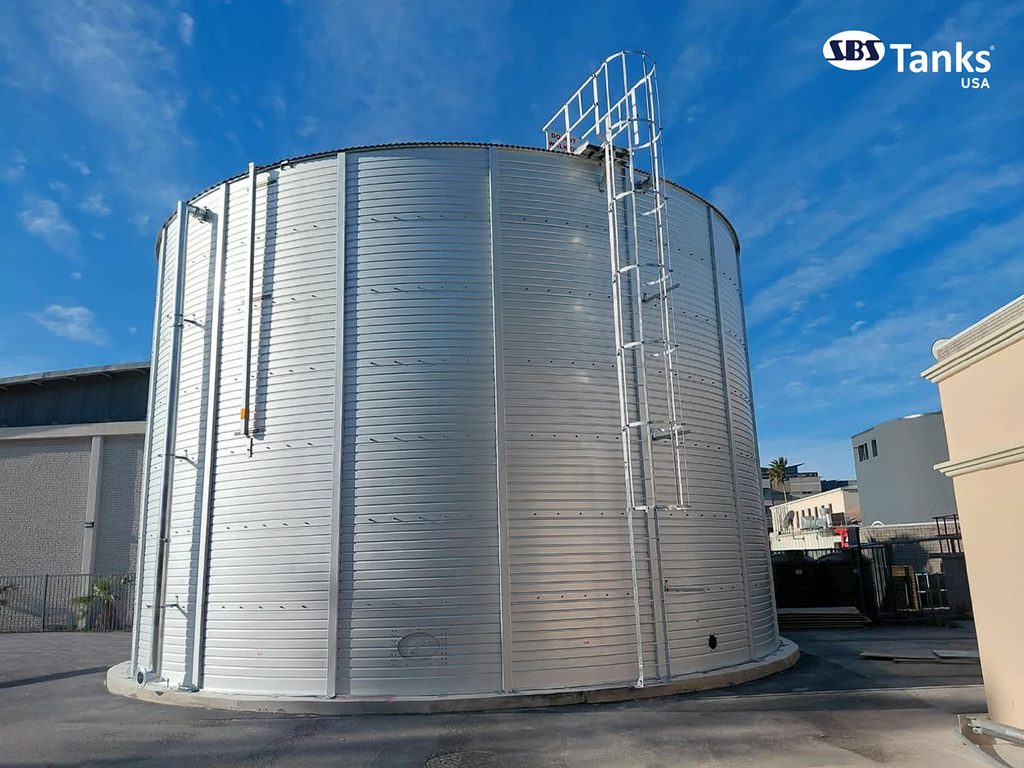
SBS Tanks provides dedicated NFPA 22 fire protection water storage solutions for projects where reliable on-site fire water reserves are required. The modular steel tanks are used across commercial and industrial applications and can be configured around required storage capacity and site-specific engineering conditions.
Click here for more information.
Considering these requirements early allows the tank, fire pump, associated piping, foundations and site access to be incorporated into the broader facility design rather than accommodated after much of the site layout has already been established.
Industrial water planning is also beginning to encompass a wider range of potential sources.
Depending on the application and applicable regulations, facilities may be able to use reclaimed or recycled water for certain processes rather than relying exclusively on potable utility water.
Rainwater harvesting presents another opportunity.
Industrial and distribution buildings frequently have substantial roof areas capable of collecting significant volumes of rainfall. When appropriately collected, treated, and stored, this water can potentially support suitable non-potable uses such as irrigation, washdown, or other site requirements.
Rainwater harvesting will not replace utility water for every facility, nor will it be appropriate for every industrial process. Its value lies in identifying where an alternative source can practically offset demand for treated water.
This changes the conversation from simply asking “How much water do we consume?” to asking “Which applications actually require potable water, and where can alternative sources be used?”
Water interruptions can affect industrial operations in very different ways.
For some businesses, a temporary interruption may create little more than an inconvenience. For facilities dependent on continuous process water, cooling, cleaning, or other water-intensive operations, the consequences can be considerably greater.
On-site storage can provide an additional level of resilience where continuity of supply is important.
The required storage strategy will depend on the operation. Some facilities may prioritize dedicated fire protection reserves, while others may require process or backup water storage. Larger developments may have several distinct water requirements across the same site.
The objective should not simply be to install the largest possible tank. It should be to understand the facility’s actual requirements and engineer storage accordingly.
SBS Tanks offers modular steel water storage solutions designed for a broad range of commercial and industrial applications, including fire protection, backup water, process and recycled water, and rainwater harvesting.
The Standard (ST) range offers capacities from 3,170 gallons to more than 1.1 million gallons, allowing storage solutions to be selected around both capacity requirements and available site footprint.
For projects exposed to more demanding environmental conditions, the Cyclonic (CY) range provides enhanced structural capabilities for industrial and fire protection installations in hurricane-prone regions. Seismic engineering options are also available where required.
The modular nature of these systems provides flexibility when engineers need to balance storage capacity against site constraints—a consideration that becomes considerably easier when water storage is incorporated during early project planning.
There is no single water challenge facing every industrial development in the United States.
That is precisely why water deserves greater consideration.
Different industries, locations, utilities, and processes create very different requirements. The most effective approach is therefore not to assume that water will be available in whatever quantity is eventually required, but to establish the facility’s complete water profile early in the development process.
How much is needed for operations? What fire flow is required? Can the utility provide it? Could captured or recycled water offset certain demands? Is backup storage necessary? And how might those requirements change if the facility expands?
Answering those questions early allows water infrastructure to become part of the facility’s design rather than a problem to solve later.
As industrial development continues across the United States, power, land, transportation and labor will remain fundamental considerations.
Increasingly, water belongs on that list too.
SBS Tanks designs and manufactures modular steel water storage solutions for fire protection, commercial and industrial operations, utilities, rainwater harvesting, agriculture, and other critical applications. With more than 25 years of international water storage experience, SBS Tanks provides solutions engineered around project-specific capacity, environmental, and operational requirements.
The company’s Standard (ST) and Cyclonic (CY) ranges provide scalable storage options for applications including NFPA 22 fire protection, process and recycled water, emergency backup supply and rainwater harvesting.
For more information, visit www.sbstanksusa.com.
© SBS Holdings 2026
